
Frazer Faculty of Education, Ontario Tech University
Mental Health in the Digital Age Lab
Researching holistic well-being and digital flourishing across the lifespan.

Recent Publications
We are excited to share a selection of our most recent publications below!
For a complete list of publications, click here!
AI, Deepfakes, and Youth Cyberbullying: New Frontiers of Digital Harm
Jennifer Laffier & Madison Westley
The rapid advancement of generative artificial intelligence has introduced new and increasingly complex forms of cyberbullying among youth. This paper examines the use of deepfake technologies in youth cyberbullying through a qualitative multiple-case study analysis of media-reported incidents. Findings reveal patterns in the creation and dissemination of deepfakes, significant psychological and social harm to victims, gaps in legal responses, and challenges faced by educational institutions. Deepfake-enabled cyberbullying is characterized by scalability, realism, and permanence, intensifying both immediate and long-term impacts. The study highlights the need for proactive, trauma-informed, and educational responses to address emerging AI-enabled harms among youth.


Childhood in the Age of Influence: Exploring the World of Kidfluencing and the Opportunities for Enhanced Digital and Media Literacy Education
Madison Westley & Jennifer Laffier
The rapid growth of kidfluencing has introduced new opportunities and risks for children and youth engaging with social media as both content creators and followers. While emerging literature has examined the psychological, social, and safety implications of kidfluencer culture, there has been little attention on the role of educators in responding to these challenges. This paper presents a narrative literature review exploring (1) the impacts of kidfluencing on child and youth well-being and (2) how K-12 educators can respond through digital and media literacy education. Findings demonstrate that young people face risks related to exploitation, privacy, social comparison, and mental health while navigating these complex digital environments. A significant gap was identified in understanding the role of educators and curricula in supporting young people engaging in kidfluencing spaces. Expanded approaches to digital and media literacy curricula are discussed to support students as both young creators and consumers of digital content.
Digital Wellness and Trauma-Informed Care in Higher Education: Fostering Global Competencies for Student Success in the Digital Age
Jennifer Laffier, Madison Westley, & Barb Perry
The mental health of post-secondary students has been an area of public health concern for the last several years, as this age group is particularly vulnerable to mental health problems and increased stress. Therefore, this paper aims to synthesize the literature on DW and TIC in higher education and propose an emerging framework for how these two approaches can serve as a foundation for fostering global competencies and overall student well-being. Although TIC and DW are increasingly recognized as important emerging approaches in higher education, they are often discussed separately rather than in conjunction. This framework explores them as interconnected, both emphasizing the need to design spaces that support individual and collective well-being, including physical and digital environments that promote safety, engagement and connection.


Resilience-Informed Mentorship in Teacher Education: An International Project Between England and Canada
Jennifer Laffier, Madison Westley, Jenny Fogarty & Leanne Gray
Resilience-informed approaches are increasingly recognized as essential for supporting both teacher candidates and associate teachers, particularly amid widespread teacher attrition and escalating mental health concerns as noted. Teaching practicums are critical opportunities for mentorship, experiential learning and professional identity development. Our current research project brings together two Faculties of Education in Canada and England to examine how teacher education can cultivate flourishing at all levels of the school community in the digital age. Specifically, this project explores how resilience-informed practices can be integrated into teacher education and mentorship to promote sustainable well-being. By examining multiple levels of the school community, we aim to develop an evidence-informed framework to support prevention- and intervention-based approaches that foster flourishing school communities. In this paper, we explore Phases 1 and 2 of this international collaboration, including the development of effective international communities of practice.
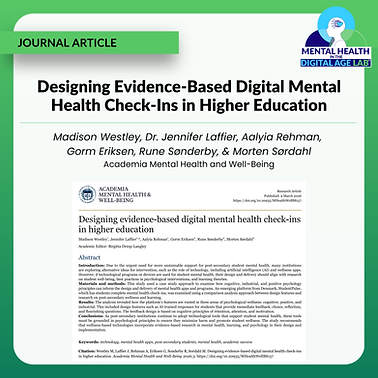
Designing Evidence-Based Digital Mental Health Check-Ins in Higher Education
Madison Westley, Jennifer Laffier, Aalyia Rehman, Gorm Eriksen, Rune Sønderby & Morten Sørdahl
Introduction: Due to the urgent need for more sustainable support for post-secondary student mental health, many institutions are exploring alternative ideas for intervention, such as the role of technology, including artificial intelligence (AI) and wellness apps. However, if technological programs or devices are used for student mental health, their design and delivery should align with research on student well-being, best practices in psychological interventions, and learning theories. Materials and methods: This study used a case study approach to examine how cognitive, industrial, and positive psychology principles can inform the design and delivery of mental health apps and programs. An emerging platform from Denmark, StudentPulse, which has students complete mental health check-ins, was examined using a comparison analysis approach between design features and research on post-secondary wellness and learning. Results: The analysis revealed how the platform’s features are rooted in three areas of psychological wellness: cognitive, positive, and industrial. This included design features such as AI-trained responses for students that provide immediate feedback, choice, reflection, and flourishing questions. The feedback design is based on cognitive principles of retention, attention, and motivation. Conclusions: As post-secondary institutions continue to adopt technological tools that support student mental health, these tools must be grounded in psychological principles to ensure they minimize harm and promote student wellness. The study recommends that wellness-based technologies incorporate evidence-based research in mental health, learning, and psychology in their design and implementation.

How Digital Wellness is Represented in School Digital Literacy and Citizenship Models: A Qualitative Comparative Analysis
Jennifer Laffier, Madison Westley, & Aalyia Rehman
Research has begun to examine the role of digital wellness in educational contexts, suggesting that cultivating competencies such as self-regulation, emotional resilience, and intentional technology use may support healthier digital engagement and enhance both academic learning and student well-being. Despite its relevance, digital wellness remains underrepresented in educational discourse, often overshadowed by the dominant emphasis on digital literacy and digital citizenship in schools. Using the Qualitative Comparative Analysis-Based Research Synthesis (QCARS) method, this paper explored the representation of digital wellness within existing digital literacy and digital citizenship educational models or frameworks. In alignment with QCARS methodology, the synthesis was both descriptive and interpretive. Educational frameworks and models from the last 10–15 years (N = 15) were analyzed using a truth table informed by the QCARS method. Results revealed that fourteen of the twenty-four frameworks incorporated digital wellness constructs to varying degrees. The majority referred to digital wellness as a ‘subcomponent’ of digital literacy or digital competence, affirming their status as educational priorities globally. A notable observation, and a potential limitation of this analysis, is the terminological ambiguity, posing challenges for identification and comparison. As schools continue to navigate increasingly digital environments, cultivating not only digital competence but also digital wellness is critical.
Navigating Digital Wellness for Teens with Mental Health Needs: Developing an Evidence-Based Toolkit to Support Youth Well-Being
Jennifer Laffier, Madison Westley & Melissa Farrow
This paper examines the development of an evidence-based digital wellness toolkit for teens experiencing mental health issues and undergoing treatment. A literature review revealed that this group is more susceptible to the adverse effects of technologies such as social media and excessive screen time, including compulsive scrolling, social comparison, sleep disturbances, and exposure to distressing content. Digital wellness can be a protective factor for them, providing the skills and support they need to balance healthy technology use. A critical analysis of evidence-based research revealed strategies such as mindful technology use, setting screen time limits, building digital boundaries, managing emotional triggers, and promoting better sleep habits. The toolkit was designed to provide adults working with at-risk youth, including parents and mental health staff, information and strategies to develop a digital wellness plan that can co-exist with treatment or intervention strategies.


‘Digital Identity Congruence’: Exploring the Importance of Congruent Online Identities for Adolescents
Jennifer Laffier & Madison Westley
Social media platforms such as Instagram, TikTok, and Snapchat have become prominent arenas for adolescent identity exploration and expression. However, the fluidity and duality of online self-presentation introduce new psychological risks, including digital identity incongruence, which stems from a lack of alignment between one’s online digital identity and authentic self, leading to psychological distress. This chapter explores how digital identity congruence can play a critical role in supporting psychological well-being during this formative developmental stage. Based on theoretical and empirical research, four key areas of intervention are proposed: (1) Positive Youth Development (PYD) approaches that empower identity formation, (2) supportive relationships that foster authenticity and social acceptance, (3) promotion of self-awareness and self-acceptance as protective factors, and (4) technology design and policy focused on health promotion and congruent self-expression. These insights demonstrate that congruence can be developed through reflective digital engagement, supportive relationships with peers and adults, and intentional technology use. This study contributes to the growing fields of youth, identity, mental health, and technology, by identifying congruence as both a developmental need and protective factor for adolescent well-being. Implications for educational programming, psychological and mental health interventions and practices, and ethical technology design are also discussed.
The Art of Mentoring Trauma-Informed Educators: Considerations for Teacher-Education Programs
Jennifer Laffier, Madison Westley & Aalyia Rehman
This chapter includes an interdisciplinary overview and synthesis of literature examining the role of mentorship in the development of trauma-informed educators in teacher education programs. Many students and educators in Canadian schools may have experienced trauma, which can impact their learning and performance. Trauma-informed care (TIC) practices can support all individuals within a school community and foster environments that promote well-being and flourishing. Mentors in a teacher candidate’s (TC) journey play a critical role in their development as educators, including associate teachers, Faculty of Education instructors, and peers. These mentorship relationships present a unique opportunity to help TCs learn the skills, knowledge, and attitudes necessary to become trauma-informed educators through knowledge sharing, role modelling, collaboration, and ongoing reflective practices. The levels and opportunities for mentorship in a TC’s community, along with key mentor training needs and recommendations for integrating TIC into mentorship practices, are explored. These recommendations include a focus on shifting educator perspectives in addition to knowledge acquisition.


A Conceptual Framework to Understand the Relationships Between Digital Wellness and Artificial Intelligence
Jennifer Laffier, Aalyia Rehman & Madison Westley
Digital wellness focuses on the healthy relationships individuals develop with technology to thrive, emphasizing skills such as emotional intelligence, mindfulness, mental health literacy, and critical thinking. This study employs a qualitative research approach to propose a conceptual framework that aligns digital wellness skills with healthy engagement in artificial intelligence (AI). A six-step thematic analysis was conducted to identify key themes in the literature on AI and digital wellness. The findings suggest digital wellness skills moderate healthy AI engagement by reducing risks and increasing benefits. Schools, workplaces, and communities should focus on promoting digital wellness education and skill development. Further empirical research is necessary to explore the implications of the proposed framework and evaluate its applications in real-world settings.
Navigating Digital Wellness: A Toolkit for Teens with Mental Health Needs
Melissa Farrow
This toolkit explores practical and evidence-based strategies to support teens navigating the digital age and how we can promote digital wellness skills to help them take control of their digital habits and thrive in their digital world. This document may be used with permission of the author.


Tech with a Conscience: A Technology Intervention for Student Mental Health
Jennifer Laffier, Madison Westley, Aalyia Rehman, Gorm Eriksen, & Rune Sønderby
Post-secondary campuses are overwhelmed trying to support students' mental health needs, with some reports suggesting that over 60% of students meet mental health crises. Due to the urgent need for more sustainable support in student mental health, many schools are exploring creative or alternative ideas, such as the role of technology. If technological programs or devices are used for student mental health, their design and delivery should align with research on student well-being, learning principles, and best practices in psychological interventions. Although evaluation methods often examine their effectiveness, there should also be an evaluation of their design. This can support the tools' usability and usefulness, promoting proactive mental health support through features such as screening for early detection, psychoeducation, and personalized interventions. This paper explores how technology tools for mental health can be evaluated based on mental health research and learning theories. We present a case study of a Denmark program, StudentPulse, that provides mental health support for post-secondary students. An evaluation of the tools presents examples of how evidence-based their design is. This includes features such as immediate feedback, validation, and completion length. Recommendations for evidence-based mental health technologies such as this are provided.
Exploring Digital Wellness: A New Psychological Framework that Supports Psychoeducational Practices
Jennifer Laffier
As we move further into digitally enriched worlds, children and youth must have the skills and knowledge to thrive. Youth can benefit from 21st-century skills and global competencies such as media literacy, critical thinking, and global citizenship. In response to the focus on the 21st-century learner, many educational settings adopted Digital Literacy and Digital Citizenship models. Several valuable frameworks were adapted and have been used by educators to teach children how to be wise and safe technology users and creators. However, an area garnering more attention is digital wellness, which grew from the awareness of technology's impacts on mental health and well-being. Although digital wellness was recognized in some digital literacy and citizenship frameworks and discussions, it deserved its framework from a psychological lens that would benefit therapeutic and psycho-educational practices, including those in education. This research aimed to create a framework to inform policy education and treatment in digital wellness, an essential skill for thriving in a digital and ever-changing world. Using grounded theory, a new framework for digital wellness was created: the Psychological Digital Wellness Model (P-DW). This paper highlights the new framework's components and how it can inform educational and psychological practices to support student and educator well-being.


The Promise of Digital Wellness to Promote Youth Well-Being and Healthy Communities
Jennifer Laffier, Aalyia Rehman & Madison Westley
The chapter explores how digital wellness can enhance youth interpersonal skills and relationships to contribute to their well-being and community wellness. A literature review was conducted to investigate how digital wellness influences individual well-being, mainly through developing interpersonal skills, and how this may, in turn, support community well-being. The findings suggest that digital wellness is vital in enhancing youth well-being by fostering essential interpersonal skills such as emotional intelligence and empathy, addressing key developmental needs, and nurturing positive emotions. This promotion of individual well-being, in turn, promotes community well-being; youth engage with each other in more optimistic, ethical, and inclusive ways. Digital wellness should be explored further as a key skill for healthy interpersonal relationships in a digital age.
Deepfakes and Harm to Women
Jennifer Laffier & Aalyia Rehman
As deepfake technologies become more sophisticated and accessible to the broader online community, their use puts women participating in digital spaces at increased risk of experiencing violence online and abuse. In a ‘post-truth’ era, the ability to discern what is real and what is fake allows malevolent actors to manipulate public opinion or ruin the social reputation of individuals to wider audiences. While the scholarly research on the topic is sparse, this study explored the harm women have experienced in technology and deepfakes. Results of the study suggest that deepfakes are a relatively new method to deploy gender-based violence and erode women’s autonomy in their on-and-offline world. This study highlights the unique harms for women that are felt on both an individual and systemic level and the necessity for further inquiry into online harm through deepfakes and victims’ experiences.
